Read these questions and answers carefully if you’re considering entering the event. If you’re not into reading, just watch this short video.
Budapest-Bamako is a charity rally, competition and crazy driving adventure from Budapest to Bamako. Budapest-Bamako is for those who’ve dreamed about the Dakar, Africa, the Sahara and hitting the open dirt under extreme circumstances. B2 is a minimal assistance event, which means that if you’re in trouble you can only count on yourself and your mates. You can enter in competition and adventure category. B2 is not a Sunday drive or picnic in the park. It’s not an organized package holiday. It’s a grueling two week drive on hostile terrain.

Thanks to years of experience we have a good sense of how much it should cost. You should be aware of your car’s fuel consumption and your needs along the way. There are teams who camp by the side of the road every night. Other spend money on champagne and fancy hotels. The following calculation is a relatively middle of the road budget. It can be lower and can be higher.
The price of the vehicle and the entry fee is not included in this budget.
| VISAS | 350 Euro |
|---|---|
| VACCINATION | 230 Euro |
| INSURANCE + PERMITS | 550 Euro |
| FUEL | 800-1500 Euro |
| ROAD TOLLS | 150-190 Euro |
| FERRY | 300-450 Euro |
| ACCOMMODATION | 200-500 Euro |
| FOOD | 500 Euro |
| MECHANIC | 400 Euro |
| SLUSH FUND | 100 Euro |
| PLANE TICKET | 1000 Euro |
| TOTAL | 6010-7000 Euro per 2 Person,1 Vehicle |
So for 6000-7000 Euros 2 people can comfortable manage the rally. If you come with 2-3 other friends you can reduce the per person costs greatly by splitting expenses.
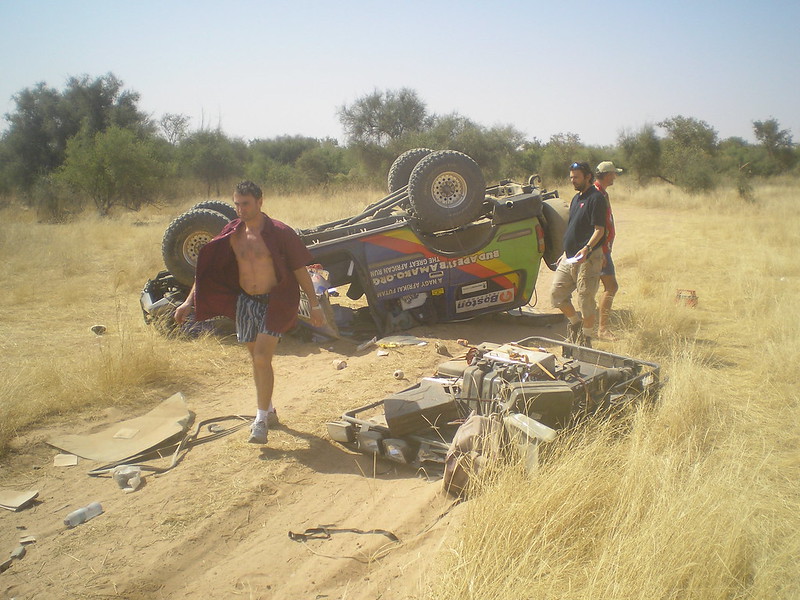
The Budapest-Bamako is not a Sunday picnic or an afternoon joyride down the coast. It has its many dangerous elements. You can reduce all the risks and you can prepare for scary situations, but there is one very important rule: in case of danger, you can count only on yourself.
Accidents can happen anywhere, any time.

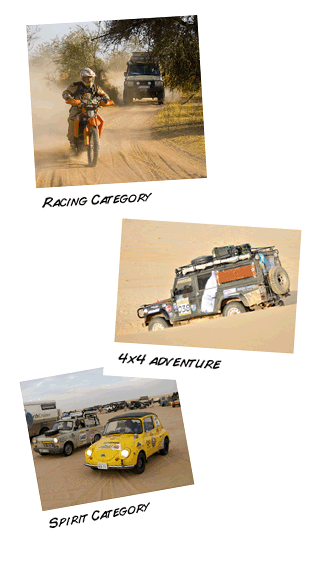
RRACING CATEGORY: In racing category participants have to complete daily stages from one camp to another. Along the road they will have to find geo-challenges, which are navigational points, usually given by GPS coordinates. These points have to be visited, photographed and entered on a daily race sheet. Teams can collect points for completing the daily stages and reaching the geo-points. Penalties are given for missing daily stages or speeding in residential areas. The team with the most points wins. Enudrance, navigation and driving skills matter. Speed is not a deciding factor.
44×4 TOURING CATEGORY: There are no points, no geo-challenges and no tasks to complete. You’ll get a detailed road book with the daily stages, a few daily navigational aids and you’re free to roam and discover. The touring category is about adventure, discovery, connecting with other people and visiting places you never knew existed in the world. However the road can be difficult and a good 4×4 vehicle or off-road bike is highly recommended.
TTOURING CATEGORY: You don’t need a 4×4 vehicle. You can complete this rally category in a passenger car. It doesn’t mean that there will not be dirt roads or difficult sections.
SSPIRIT CATEGORY: This category is essentially the same as Touring. However teams in the Spriti Category have their entry fee waived. Yes, if you preserve the original founding “spirit” of the rally you can come for free. There are only 20 spots left each year and you have to submit your idea for your vehicle early on. If your idea is accepted, you’re in.
The founding motto of the Budapest-Bamako has not changed.
You can entry by car, motorcycle, truck, ATV, side by side even with a shopping cart or on roller skates. However, we ask you to be at least 18 years of age.
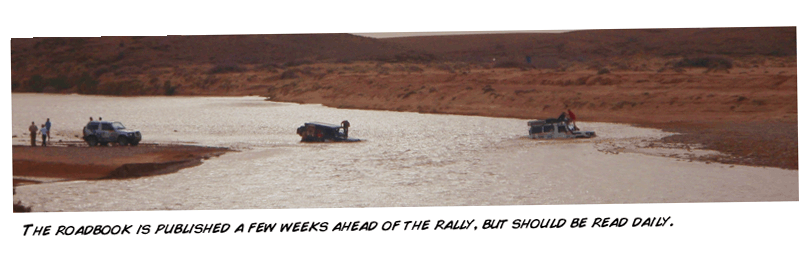
The Roadbook is your detailed guide to the daily stages and the countries and territories we travel through. It contains practical information about driving in the Sahara, local conditions, food and supplies, road conditions, border crossings and other useful information you may need along the way.
It also includes information about each stage, as well as the official hotels, campsites and other important locations.
The Roadbook is usually published 2 weeks before the start and will be available for download on the Team Info site.
Race Sheets are different from the Roadbook. They contain the geo-challenges and navigation points for each racing day and are handed out to participants at the official campsite each morning. Completed Race Sheets must be submitted to the referees at the end of the stage.
Race Sheets are provided only to teams competing in the Racing category.

It is important that every vehicle has valid registration documents, European insurance (Green Card), and compulsory third-party vehicle insurance valid in the African countries we travel through. These documents may be checked at border crossings and checkpoints along the route.
If the vehicle is not registered in the driver’s name, an authorization letter in both English and French is required. A template is available on Team Info. We strongly recommend having the document officially certified and stamped wherever possible. Traveling with a vehicle registered in someone else’s name without proper authorization can cause serious problems at borders and checkpoints.
The compulsory African vehicle insurance must be arranged through our office.
A Carnet de Passages en Douane (CPD) is not required in any of the countries on the route for official Budapest-Bamako participants and their registered vehicles.
We arrange all required visas centrally for every officially registered participant. The visa process is handled by our office and cannot be arranged individually by participants. Handling the visas as a group makes the process considerably easier, especially in countries where entering through land borders requires special permits or advance arrangements.
You do not need to submit your passport for the visa process.
It is extremely important that your Team Info page is 100% complete and that all information provided is accurate. All required documents and passport copies must also be uploaded. We arrange the visas based on the information provided in Team Info, so we cannot guarantee that visas will be issued correctly if any information is missing or incorrect.
The final deadline for completing all required information and documents in Team Info is November 18, 2026. The system will close on this date.
Visa arrangements are available exclusively for officially registered participants listed in our system.
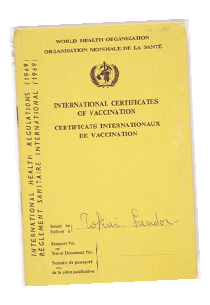
Your best bet is to contact a travelers’ clinic in your home country and inquire about shots and medical precautions needed before undertaking a trip to West-Africa.You get a so called “yellow-book” about your shot against yellow fever. This book is almost as important as your passport. You can’t enter Mauritania, Senegal, Guinea and Sierra Leone without this. Next to the shots it is important to have a medical kit with you. In the roadbook you will have detailed information about this.
We recommend packing a medical kit with the following:
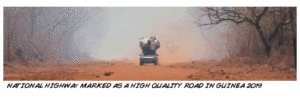
The route of the adventure category goes on the road of your choice. The rally travels on roads indicated on roadmaps. However some of those roads are in horrible shape. In Mauritania, Senegal, Guinea and Sierra Leone the marked roads are not the highest quality. This may cause difficulty for two-wheel-drive cars, but it is not impossible. Locals also drive junky 2wheel drive cars in many cases.

The racing category will be hard. If you want to complete all the stages, you have to come with a 4-wheel-drive car. It is not impossible with a two-wheel-drive, but it is sure that you will have to shovel, push and to ask for the help of the locals, if you would like to get every point. In 2010 a 1957 VW Beetle got stuck in the sand in the Moroccan Sahara. He was rescued by a local trucker after loading the bug onto the truck. There is always a solution.
The more maps you have the better. We recommend getting a Michelin 741 Map and also a good map of Morocco and Senegal. Finding maps about Guinea and Sierra Leone will be harderm but not impossible. There’s another important map, which you can’t buy anywhere. It’s even hard to find it on the net. We have it. Download it from here and bring it.
Map Of Banc d’Arguin National Park in Mauritania
Apart from the maps, you should also bring a GPS. You will need a GPS and not a navigation tool. Do not rely on your smart phone for navigation.
We recommend using an durable, shockproof, dustproof Android tablet with the Budapest-Bamako offroad map uploaded. This map can ordered from us and will be uploaded on an SD card. Another solution is a Garmin compatible device. Make sure that you can enter GPS coordinates and you can upload maps to it.
We offer a full range of GPS maps to participants and GPS solutions.
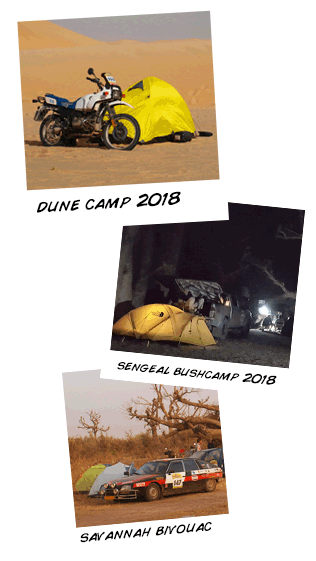
Every night a hotel or campsite aka bivouac will mark the end of the day’s stage. In bigger towns we’ll spend the night in two-three star hotels. Outside of the cities you will be sleeping in your own tent. Participants will receive an official list of hotels though no one is obliged to stay at these facilities, and it is possible, that not everyone will get a room. Even if you make a reservation and prepay it doesn’t mean that it’ll be there when you arrive. Get a good sleeping bag and a reliable tent. Most of the nights will be spent in bivouacs.

Your return journey from the finish line is completely up to you. What you do with your car after the rally is also your decision. Here are the most common options teams choose at the finish line:
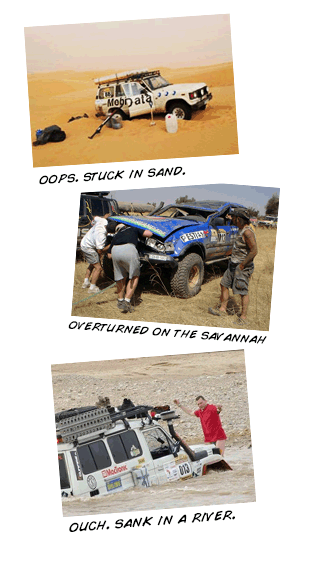
This is one of the most frequently asked questions. The best solution is the prevention. Never go alone! Never go far away from the official route where others may show up to help. No one has ever got stuck in the Sahara forever. The first solution is that you ask for help using your satellite phone or on CB radio and a participant who is near to you pulls you out takes you to the day’s end stage or helps you. The second is that a local pulls you from the trouble. It can be surprising, but in the Sahara there are people everywhere. The third solution is to walk to a paved road and you call help. In 2008 two participants got stuck in soft sand with motorcycles. They walked for 12 hours to the paved road, where they found a local truck, which pulled them out. The official road book contains important information for situations like this and a more detailed trouble shooting manual.
We are also happy to report that no one has ever gotten completely lost or vanished on one of our rallies. Keep an open mind. Have a few days worth of water and food. Know where the nearest road is. Know where the nearest settlement is.

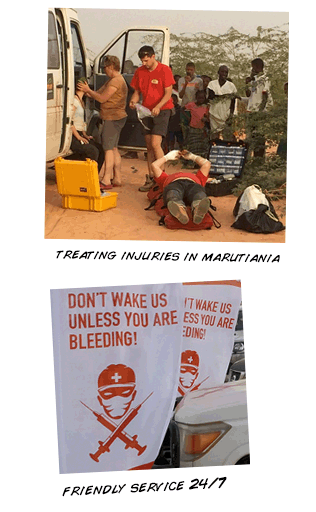
Every year, an ambulance and a professional medical crew accompany the rally. Their job is to provide first aid and deal with medical emergencies along the way.
The medical team travels along the official route every day and stays at the official camp or hotel each night. If you need medical assistance and are able to travel, make your way to the official camp and see the medical team there.
In case of a serious injury, accident or emergency, you can call our medical emergency number and a doctor or ambulance will be dispatched to your location. Depending on the distance, terrain and road conditions, they may reach you in five minutes or it may take several hours.
You can find the medical team every evening at the official camp or hotel listed in the Roadbook.
Medical assistance is available 24/7 during the rally. However, please keep in mind that this is Africa, distances can be huge and conditions can be difficult. The medical team cannot always reach the scene of an accident immediately.

Over the past two decades, the Budapest-Bamako has been through some difficult periods. There have been years when the Hungarian Ministry of Foreign Affairs strongly advised people against participating. In 2008, we went ahead with the Bamako even when the Dakar was cancelled due to security concerns.
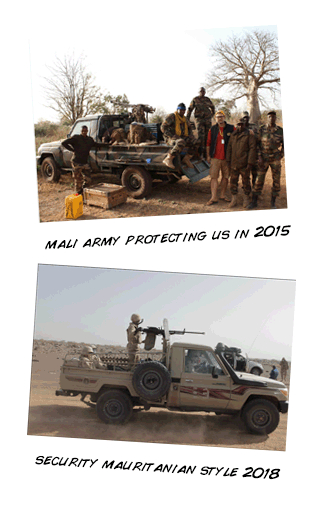
We maintain close relations with the authorities in the African countries we travel through, and our security arrangements are always adapted to the current situation. In Mauritania, for example, our camps have been protected by the military since 2008. During our most difficult year, there were sections where the entire rally travelled in a military and police convoy.
The political and security situation is constantly changing. Something that was considered a serious risk a few years ago may no longer be a problem today, while the situation elsewhere can deteriorate. This is why no security assessment made months in advance can be guaranteed to remain accurate by the time we arrive.
We continuously monitor the situation, stay in contact with local authorities and, if necessary, change the route or the program. At the same time, we ask everyone to follow current events and official travel advisories and make their own decision about participation based on the information available.
Africa has never been a risk-free travel destination, and it is not one today. Virus outbreaks, epidemics, rebellions, armed conflicts, ethnic tensions, civil wars and coups can happen at any time. You need to be prepared for this and consider these risks carefully before setting off.
Everyone participates in the rally at their own risk.
If you have additional questions please join our Facebook News & Community Group where you can ask people who have been there.
If you have an entry, just wait for the road book. It will have answers to almost every question.
If you’re considering entering and still have questions just drop us a message.